We’ve recently published the results of our 2025 Architectural Salary Survey, and the most common reaction we’ve heard so far is:
“None of this is a surprise.”
That response, in many ways, says everything.
After surveying more than 2,000 architectural professionals, the findings confirm what most people in the industry already feel: salaries have stagnated, pressure on fees has intensified, and practices are working harder in a more complex environment for diminishing returns.
The data doesn’t shock — it confirms.
What the Survey Tells Us
Here’s a concise snapshot of the key findings from the 2025 Architectural Salary Survey:
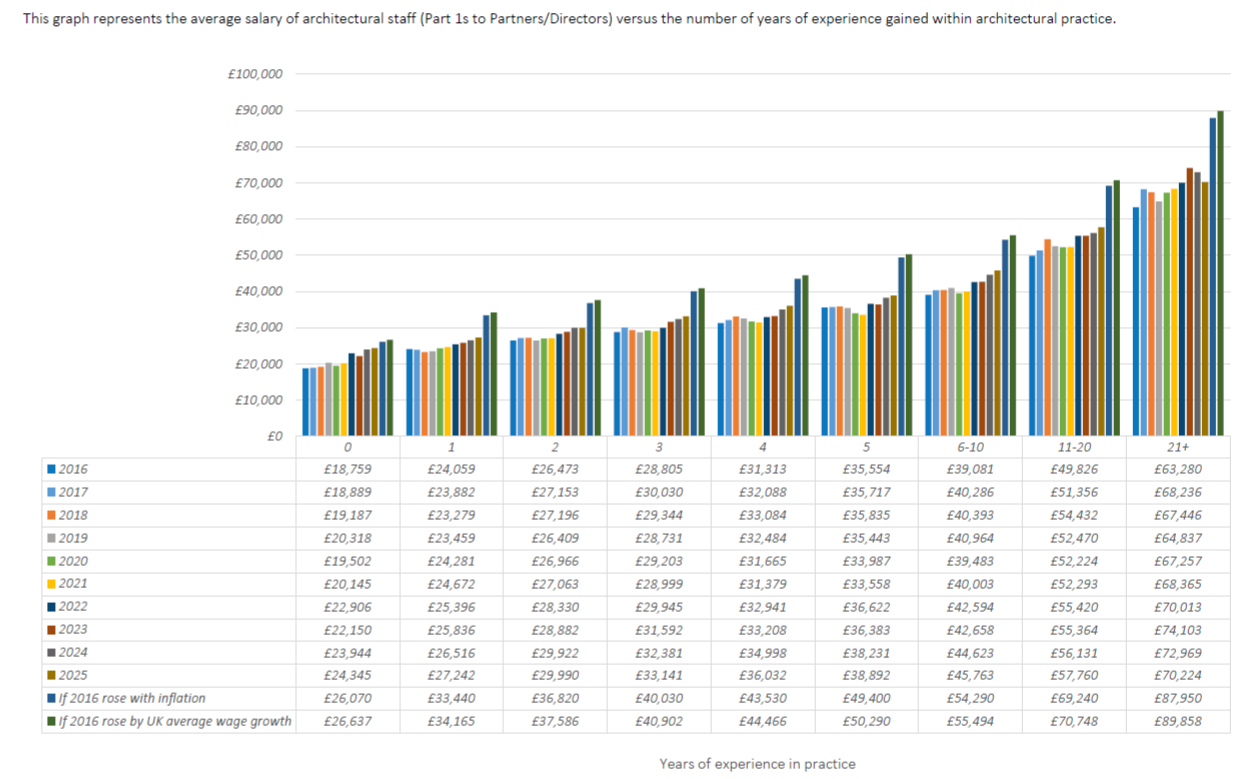
- Architectural pay has grown just 15.5% since 2016, compared with around 42% across the wider UK economy, resulting in long-term real-terms pay erosion.
- The average salary increase in 2025 was 1.5%, failing to keep pace with inflation once again.
- Many practices report being busy, yet profitability is weakening due to low fees, higher taxes, insurance costs, planning delays and regulatory pressure.
- Junior salaries have risen fastest, but from a very low base, with slow progression and heavy competition early in careers.
- Achieving Part 3 still delivers strong value, with an average uplift of £5,300.
- Gender pay gaps widen with seniority, and bonus inequality persists (48% of men received bonuses vs 39% of women).
- Bonus culture is shrinking and uneven, with only 44% receiving one in 2025.
- Certain sectors remain resilient — notably hotels, data centres, industrial and commercial retrofit.
- Client-side, developer and contractor roles continue to pay more than architectural practice.
- With limited salary growth, culture, flexibility, wellbeing and benefits are now central to retention.
 “It’s All Down to Fees”
When we ask why salaries haven’t improved, the answer is consistent:
Pressure on fees.
Architectural practices are absorbing more risk, more compliance, more administration and more uncertainty — while fees have, in many cases, gone backwards. Stagnant salaries are not a failure of intent; they are a direct outcome of the commercial model.
Which brings us to a more uncomfortable conversation.
Should Practices Specialise More?
One question that keeps resurfacing is whether architecture has tried to be too broad for too long.
For decades, many practices have aspired to be the modern equivalent of the master builder — capable of doing everything, for everyone. But in today’s market, generalism often struggles to command premium fees.
By contrast, practices that specialise — whether in sector, scale, typology, technical expertise or delivery model — often communicate value more clearly, differentiate themselves more confidently, and ultimately charge higher fees.
So are the days of the all-rounder numbered? And does greater specialisation offer a route to healthier margins — and, by extension, better pay?
AI, Efficiency and Profit
Another unavoidable question is the role of AI and automation.
If used well, AI has the potential to reduce time spent on repetitive tasks, improve coordination and checking, and increase consistency and speed across delivery stages. The opportunity is not just about working faster — it’s about working more profitably.
But that only happens if efficiency gains translate into better fee structures, stronger scope control, and a willingness to retain value rather than give it away for free.
Used strategically, AI could help shift margins. Used poorly, it simply accelerates the race to the bottom.
Do We Need to Celebrate Commercial Success More?
Architecture is excellent at celebrating design excellence — and rightly so. But perhaps the industry also needs to celebrate commercial acumen, sustainable profit, strong leadership and well-run practices.
Profit is often treated as an uncomfortable by-product rather than a marker of success. Yet without it, salaries stagnate, burnout rises, and talent drifts elsewhere.
Maybe it’s time to broaden what “success” looks like.
The Bigger Structural Questions
If fees are the root cause, then a number of difficult but necessary questions follow:
- Would a return to some form of fee guidance or fee scales help? Not to fix prices, but to re-establish a baseline understanding of value.
- Do architects need stronger protection of function and responsibility? Particularly as liability increases while influence over delivery is often diluted.
- Is this simply cyclical — dependent on a stronger, more stable economy? Or does the profession need to rethink how it positions, differentiates and defends its value regardless of economic conditions?
- Can practices realistically raise fees without collective confidence and clarity? And if not, how do margins — and salaries — ever recover?
So… Will the Next 10 Years Be Different?
If the last decade has taught us anything, it’s that hope alone won’t change the numbers.
Real improvement is likely to come from a combination of:
- Stronger and more confident fee positioning
- Greater specialisation and clearer value propositions
- Smarter use of technology and AI
- A cultural shift that values commercial success alongside design
- And, yes, a more stable and supportive economic environment
Which brings us to the most important question of all:
👉 Will architectural salaries look different in 10 years’ time?
👉 And what actually needs to change for that to happen?
We’d genuinely welcome the debate.